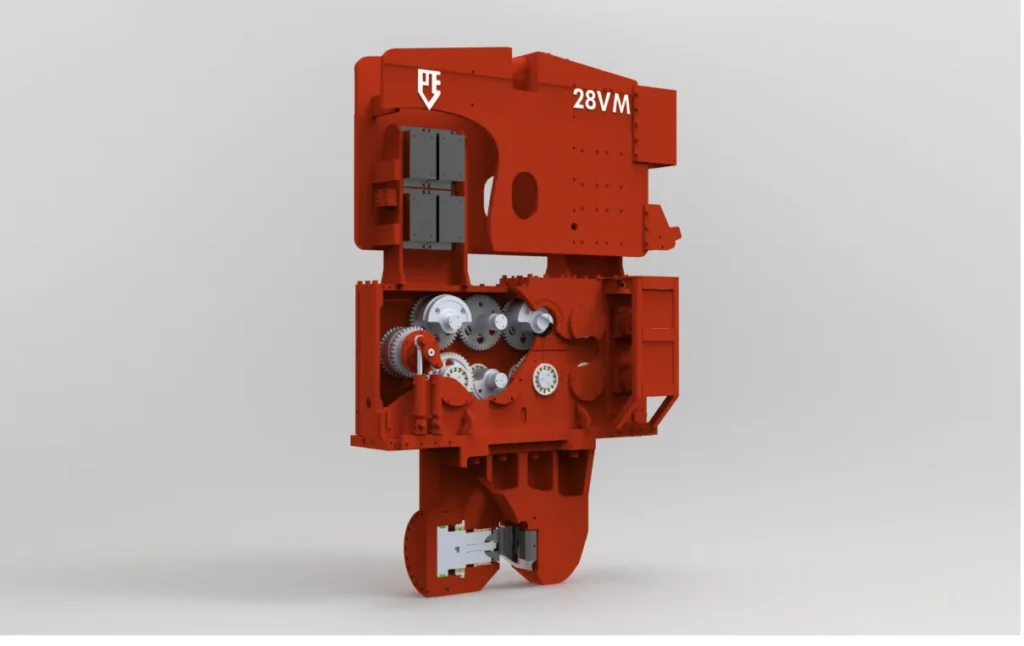
In deep foundation driving using vibratory hammers, operational focus usually centers on powerpack hydraulics, eccentric moment, or crane tonnage capacity.
However, positioned directly between the vibrating mass (gearbox) and the suspension yoke lies a critical engineering component operating under extreme dynamic fatigue: the elastomeric absorbers.
At MG Mining & Construction SAS, specialists in deep foundation machinery and specialized spare parts, we break down the technical relevance of these polymer blocks, the risks of degradation, and how preventive maintenance avoids costly downtime on site.
What Are Elastomers and How Do They Work in Vibratory Hammers?
Elastomers are engineered polymer blocks installed in the upper section of a vibratory hammer. Their primary function is to act as a dynamic energy filter.
During high-frequency operation, elastomers execute three essential mechanical tasks:
- Vibration Isolation: They absorb up to 90% of the upward vertical and horizontal oscillations, preventing destructive kinetic energy from traveling to the crane hook and boom.
- Tension & Shear Management: They maintain continuous tension between the non-vibrating yoke and the high-frequency gearbox, ensuring stable alignment during penetration and extraction.
- Shock Absorption: They cushion sudden tension spikes caused by tough soil resistance or rapid mechanical lifting.
Consequences of Operating with Fatigued or Crystallized Elastomers
Continuous exposure to compression cycles, high shear stress, hydraulic oil, UV radiation, and thermal variations leads to polymer degradation over time.
Operating a vibro hammer with degraded or expired vulcanized blocks results in:
- Structural Damage to the Carrier Crane: Unfiltered vibration reaches the boom, causing micro-cracking in welds and damaging hydraulic cylinders.
- Accelerated Wear of Upper Yoke Components: Uncontrolled movement increases friction and wear on mechanical pins, shackles, and lifting hooks.
- Loss of Energy Transfer to the Soil: Degraded elastomers fail to maintain consistent downward pressure, reducing penetration efficiency into dense soil strata.
- Catastrophic Failure Risk: Extreme tearing can cause the suspended mass to detach, creating severe safety hazards on the job site.
Diagnostic & Preventive Maintenance Guide
| Elastomer Condition | Visible / Operational Symptoms | Site & Equipment Risk Level | Recommended Action |
| Optimal | Smooth surface, uniform elasticity, no micro-cracks | None (Safe operation at maximum frequency) | Daily visual inspection and oil/grease cleaning |
| Moderate Wear | Surface micro-fissures (< 2 mm), mild hardening | Medium (Increased noise and yoke vibration) | Schedule replacement during the next maintenance cycle |
| Critical Failure | Deep cracking, rubber-to-metal separation, permanent deformation | High (Imminent risk of tearing and structural crane damage) | Immediate shutdown and full elastomer kit replacement |
Specialized Spare Parts & Technical Support with MG Mining & Construction SAS
At MG Mining & Construction SAS, we understand that a vibratory hammer halted by a failed elastomer causes severe schedule delays and financial losses.
We provide a comprehensive support ecosystem for your piling operations:
- OEM-Grade Elastomer Kits: High-durability replacement blocks compatible with leading global brands such as ICE and PVE.
- On-Site Technical Diagnostics: Engineering evaluation of rubber elasticity, wear patterns, and mounting hardware integrity.
- Fast Delivery: Complete inventory availability to minimize downtime in port, civil, and marine infrastructure projects.
Need to evaluate your vibratory hammer elastomers or request a quote for replacement kits?
Contact MG Mining & Construction SAS today to ensure maximum operational uptime for your foundation equipment.
Frequently Asked Questions (FAQ)
How often should elastomeric blocks be replaced on a vibratory hammer?
Elastomers should generally be replaced every 1,000 to 1,500 operational hours, or immediately upon detecting deep surface cracking, permanent deformation, or rubber-to-metal delamination.
Can oil leaks damage vibratory hammer elastomers?
Yes. Hydraulic fluid and oils degrade natural and synthetic polymers, causing them to swell, soften, or lose their shock-absorbing capabilities. Leaks should be repaired immediately, and elastomers kept clean.
Should elastomers be replaced individually or as a complete kit?
It is strongly recommended to replace elastomers as a complete set. Replacing only one block creates uneven load distribution, leading to premature fatigue and unstable hammer operation.